
Chasers, Cubs & Curves: How Gay Britain’s Bear Scene Got Body Positivity Right First
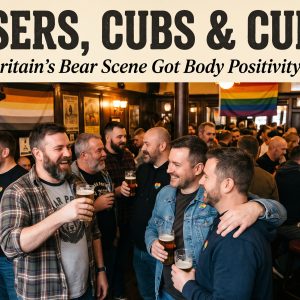
Body positivity is usually told as a women’s story, born on Instagram in the 2010s. But
one group of men was celebrating bigger bodies decades earlier, and they did it with
beards, bellies and a sense of humour.
The gay bear scene grew up in the 1980s as a reaction against a narrow ideal. Gay
men’s magazines and nightclubs were full of smooth, slim, gym-built bodies. Plenty of
men didn’t look like that and had no interest in trying. So they built a scene of their own.
Where the bears came from
In 1987, Richard Bulger and his partner Chris Nelson launched Bear magazine in San
Francisco. It started small and became the centre of a movement. Bulger is widely
credited with popularising “bear” as the name for a larger, hairier, often older gay man
who doesn’t apologise for any of it.
By 1995 the scene had its own flag. Craig Byrnes, a member of the Chesapeake Bay
Bears, designed the International Bear Brotherhood Flag. Its stripes come in the colours
of animal fur, with a paw print in the corner. He placed it in the public domain, and it now
flies at bear events all over the world.
From there the scene spread well beyond California. Bear socials, club nights and
weekends away became part of gay life in cities across the US, Europe and the UK.
A vocabulary that celebrates bodies
The bear scene came with its own language, and almost every word in it is affectionate.
A bear is big and hairy. A cub is a younger or smaller bear.
An otter is slim and hairy. A wolf is somewhere in between, often with a bit of swagger. A
chub is a larger man, and proud of it.
Then there are chasers. In bear culture, a chaser is someone who’s attracted to bears or
chubs, and it’s said with a smile. Being a chubby chaser or a bear chaser is an ordinary
thing to be, and nobody expects you to explain it.
That language did something clever. It turned body types that were mocked elsewhere
into identities people chose and enjoyed. A man who’d spent years trying to shrink
himself could walk into a bear night and find he was exactly what someone was looking
for.
Why it mattered then, and still does
The pressure on gay men’s bodies hasn’t gone away. A 2019 Mental Health Foundation
poll found 46% of gay men and lesbians had felt anxious because of their body image.
Central YMCA research found 59% of gay men compare their looks with people they see
as better looking, against 32% of straight men.
Dating apps haven’t helped. A profile is a photo first and a person second, and the
scrolling never stops. For men who don’t match the template, it can feel like the whole
gay world is filtered against them.
That’s why the bear scene still matters. It offers a different set of rules, where size, age
and body hair are features rather than flaws.
It also takes the pressure off getting older. Elsewhere on the gay scene, turning 40 can
feel like a deadline. Among bears, a grey beard and a bit of a belly are often what gets
you noticed.
The same word, a different meaning
Here’s where the bear dictionary needs a footnote. “Chaser” is a warm word among
bears, but it carries a different weight elsewhere.
In trans dating, “chaser” is used for men who fetishise trans women. These men are
interested in a body, or a fantasy, and not much else. Trans women use the word as a
warning, and it’s rarely meant kindly.
The difference comes down to respect. A bear chaser fancies big men and treats them
as whole people, with lives, jokes and friends of their own. A chaser in the trans sense
treats a woman as a category to tick off. Anyone curious about being a good date for a
trans woman will find the same principle at the heart of it: see the person first.
It’s a useful reminder that attraction to a particular body type isn’t the problem. Reducing
someone to their body is.
What curvy women and bears have in common
Readers of a site built around curvier women will recognise much of this. Bigger women
and bigger gay men have faced similar messages: lose weight, cover up, be grateful for
any attention.
Both groups have answered in similar ways too. They’ve built spaces where bigger
bodies are the point, and found partners who prefer them. The BBW community and the
bear scene are cousins in that sense, even if they rarely share a dance floor.
Both have also had to deal with people who mistake enthusiasm for permission. A man
who loves curves is welcome. A man who treats a curvy woman, or a big bear, as a
novelty isn’t.
Bears in 2026
Today the bear scene is bigger and more varied than its founders could have imagined.
There are bear holidays, bear nights, bear prides and endless online communities.
Younger men are joining in, and so are men of every background.
It’s also become part of the wider conversation about body confidence. Men who once
felt invisible now have a scene, a flag and a vocabulary that puts them in the spotlight.
Some gay men want company without the guesswork of the apps. Directories of verified
gay male escorts list men of every age and build, bears included. Verified profiles mean
the man you meet matches his photos, which takes the anxiety out of a first meeting.
The lesson worth borrowing
The bear scene’s biggest achievement wasn’t the flag or the magazines. It was proving
that you don’t have to change your body to find people who’ll love it. You only have to
stop believing the people who said otherwise.
That lesson works for everyone, whatever their size and whoever they fancy. Find the
people who think you’re exactly right. Then stop apologising for the space you take up.